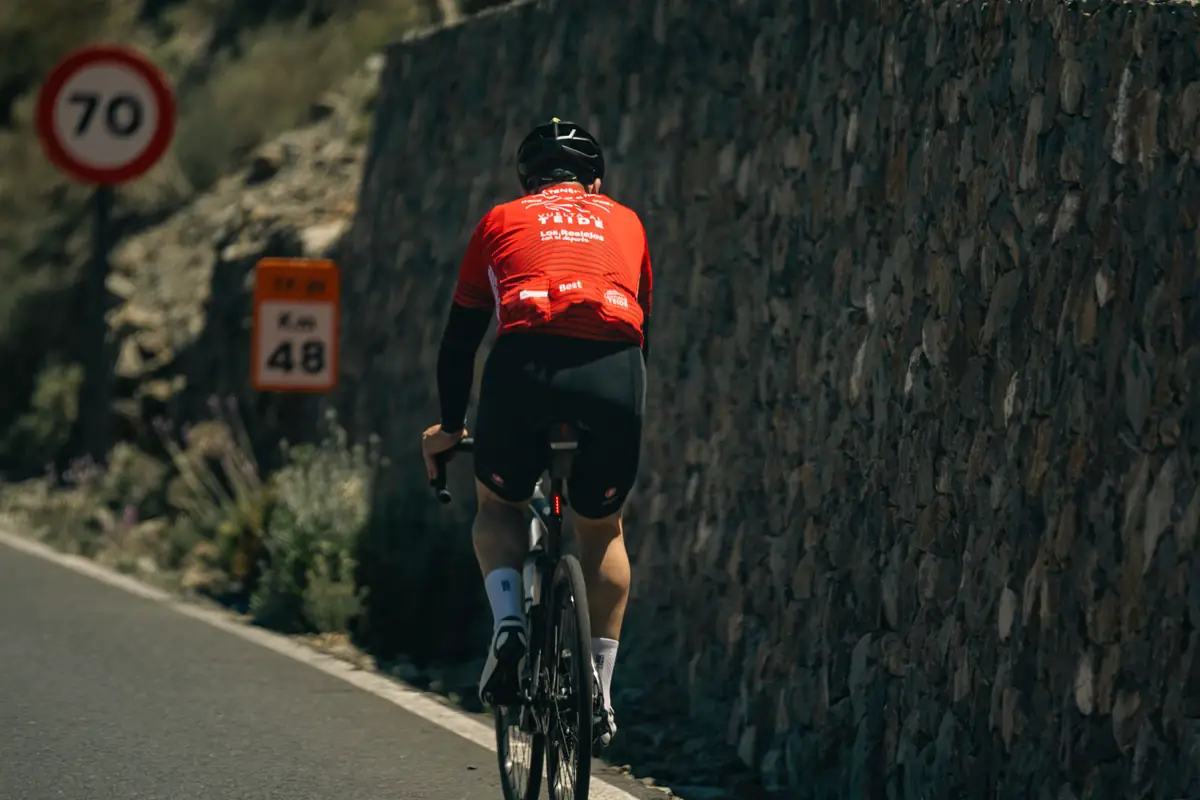
A steep hill exposes the spec that marketing likes to skip. Top speed is a flat-road number. "Up to 80 miles" is usually an Eco-mode loop with a light rider and no grade. The climb cares about torque, whether that torque can go through the gears, how low the easiest gear is, and whether the battery is large enough to pay for the hill twice a day.
This guide uses three current bikes to make that concrete: the Velotric Discover M, the Aventon Aventure M, and the Ride1Up Vorsa. Two are mid-drives. One is a high-torque hub under $2,000. Prices were checked on October 10, 2026. We have not ridden them. Nothing below is a measured grade, a stopwatch, or a thermal image of a motor. It is the manufacturer's published hardware, and what that hardware can and cannot do.
If payload is the real constraint, start with the heavy-rider guide. If you need to stay under $2,000 and the hill is only part of the decision, the Ride1Up vs Aventon vs Velotric comparison includes the Vorsa and two other hub bikes.
Torque, watts, and the sentence on the spec sheet
Torque is newton-meters. It is the force trying to turn the wheel. A higher published torque is the first filter for a hill, and it is not the whole filter.
Watts are the rate of that work. Brands now print two of them, and the smaller one scares people for no good reason. The Aventure M's motor line is an Aventon A100 mid-drive, 250 watts sustained, 750 watts peak, 100 Nm. The 250 is a continuous rating. The 750 and the 100 Nm are what the page is claiming the motor can do in a burst and as torque. Comparing that bike to a "750 watt" hub by the sustained number alone is how a capable climber gets thrown out of a spreadsheet.
The Discover M's spec line is 500 watts, 960 watts peak, 100 Nm. The same product page also prints "100 Nm torque, 130 Nm max." We kept 100 as the rated figure and 130 as the max the page itself adds.
The Vorsa is a 750 watt AKM rear hub with 95 Nm. Peak watts are not published. The dash in the table is intentional. Ninety-five newton-meters is still a serious hub figure. It is not a mid-drive figure, because the motor sits in the wheel.
A practical way to hold all of that: use torque to decide whether the bike is even a hill candidate, use sustained versus peak so you do not misread a European-style continuous rating, and then look at the gears. The gears are where mid-drive and hub stop being the same kind of machine.
Why a mid-drive can use a low gear and a hub cannot
Your legs already know this. On a steep pitch you shift into an easier gear so each pedal stroke is slower and stronger. A mid-drive motor sits at the crank and sends power through that same chain and those same gears. When you downshift, you multiply the motor's torque at the rear wheel the same way you multiply yours. The motor can stay in a speed range it likes instead of grinding at the wheel in a single ratio.
A hub motor is the wheel. It does not go through the cassette. Shifting still helps your legs, and it still matters when the motor is off or fading, but it does not multiply the motor. The newton-meters printed for a hub are what the wheel gets in every gear. That is why a 95 Nm hub and a 100 Nm mid-drive are not a five-newton-meter race. On a gentle grade they can feel similar. On a long, steep, loose climb, the mid-drive's low gear is the difference the spec sheet is hinting at when it bothers to publish an 11–46 cassette instead of an 11–32.
Mid-drives in this guide cost $2,499 and $2,899. The hub starts at $1,595. A mid-drive also loads the chain more, so keep it clean. Hub motors on a long grade sit in one thermal load. They can get hot. We have not measured case temperatures on these three bikes, so this is the mechanism, not a test result: a hub cannot downshift its way out of a high load, and a mid-drive can. On a one-minute rise that distinction is academic. On a mile of 8 to 12 percent, twice a day, it is the reason to spend the mid-drive money.
The low gear is a spec, not a vibe
Here is the gearing these three pages actually print.
The Discover M uses a Shimano Cues 9-speed drivetrain, a 46 tooth chainring, and an 11–46 cassette. The biggest cog is 46. Paired with a 46 tooth ring, the easiest gear is a 1:1 ratio. That is a real climbing gear. Combined with a mid-drive, it is the best published gear range in this guide.
The Aventure M uses Shimano Cues 10-speed, a 44 tooth chainring, and an 11–39 cassette. The easiest gear is a bit taller than the Discover M's (44 front, 39 rear, so you are still turning the cranks slightly faster than the wheel). It is still a much easier gear than a typical commuter 11–32. Ten speeds and a mid-drive on 26 × 4 inch tires is the loose-surface package: gravel, dirt, sand, a steep street that is also broken.
The Vorsa uses Shimano Acera 8-speed, a 48 tooth chainring, and an 11–32 cassette. The easiest gear is 48 front and 32 rear. That is a road-ish low gear. Your legs can spin it on a moderate hill. The hub's 95 Nm has to cover what a lower cog would have given a mid-drive. Ride1Up calls this motor its strongest hill-climbing motor, and 95 Nm is why that sentence is plausible. The cassette is why we would still rather have the Discover M's 11–46 if the grade is the whole point of the purchase and the extra thousand dollars is available.
None of these pages prints a percent grade the bike will climb, or a speed it will hold at that grade, with a stated rider weight. Anyone who gives you "this bike climbs 15 percent at 12 mph" without a test protocol is guessing. We will not.
Battery size is the hill you ride home
Climbs spend watt-hours. The way back down does not refund all of them. Regenerative braking is not a spec on these three bikes, so do not count on the descent to refill the pack.
The Discover M battery is 48 volt, 16.7 amp-hours, 801.6 watt-hours. That is the largest pack in this guide. Claimed pedal-assist range is 95 miles, throttle range 70 miles, for a 187 pound rider in Eco on flat roads. The hill version of that ride is shorter. The larger pack is still the right direction if the climb is daily and the charger is at one end of it.
The Aventure M uses the same 36 volt, 20 amp-hour, 733 watt-hour pack as the hub-drive Aventure 3. Claimed range is up to 85 miles on the same 165 pound, flat, Eco footnote Aventon uses across these bikes. You are buying the mid-drive and the gearing, not a bigger battery than the hub Aventure.
The Vorsa pack is 48 volt, 15 amp-hours, published as 720 watt-hours on Ride1Up's launch article. Claimed range is 30 to 60 miles depending on weight, terrain, incline, and assist. For a hill buyer, that sentence is more honest than a single "up to" number, because it already names incline. It is also a smaller promise. If your route is hilly and long, 720 watt-hours at high assist can be a one-way battery. We cannot tell you the mileage. We can tell you not to plan a 50 mile hilly loop on the top of that band.
Velotric Discover M
The Discover M is $2,499. The spec line is 500 watts, 960 watts peak, 100 Nm, and the same page also prints 130 Nm max. The cassette is Shimano Cues 9-speed, 46 tooth ring, 11–46, in front of an 801.6 watt-hour battery. That combination is the climbing case: rated torque, a real low gear, and the largest pack here.
Payload is 440 pounds and the rack is 66, so this is a rider's hill bike, not a cargo bike. Listed weight is 60 pounds without fenders, kickstand, and pedals. With the suspension seatpost, Regular is about 5 feet 2 inches to 5 feet 11 inches and Large about 5 feet 9 inches to 6 feet 7 inches. Frame style is not on the spec sheet, so the table leaves it blank. Brakes are Tektro hydraulic, 180 mm. A throttle is included. Class can be 1, 2, or 3, with a 12 to 28 mph adjustable range where that is legal.
Aventon Aventure M
The Aventure M was $2,899 on October 10, 2026. Aventon's comparison with the hub Aventure 3 calls the gap $900, at $1,999 for that bike. Shared parts are the 733 watt-hour battery, 26 × 4.0 inch tires, the 400 pound total weight limit, and an 80 mm fork. The hill parts are the motor, the gears, and the front brake.
The motor is the A100 mid-drive: 250 watts sustained, 750 watts peak, 100 Nm. Gearing is Shimano Cues 10-speed, 44 tooth ring, 11–39 cassette. The front rotor is 200 mm, with 180 mm at the rear, the largest front rotor in this guide. Weight is 73 pounds. Fit matches the step-over Aventure 3, 5 feet 3 inches to 6 feet 4 inches. It ships as Class 1. Aventon says an aftermarket throttle makes it Class 2, and a Class 3 conversion is offered. If you will not start a steep stop without a throttle, this bike does not include that habit.
The 400 pound limit has the same wording question as the Aventure 3, covered in the heavy-rider guide. Fat tires cost energy on pavement and help when the steep part is also soft. Claimed range is 85 miles on Aventon's 165 pound, flat, Eco test. That is not a hilly commute. Aventon is claiming the mid-drive beats the hub Aventure's 65 mile figure on the same battery and the same footnote.
Ride1Up Vorsa
The standard Vorsa starts at $1,595. It is the same 750 watt, 95 Nm hub, 720 watt-hour battery, 440 pound payload, and 203 mm rear rotor as the fat-tire FT, which starts at $1,695. This row stays with the standard bike because the hill question is torque and gearing. If the hill is also sand or snow, price the FT and keep the motor numbers. The heavy-rider guide is where the FT lives.
Class 1 through 3, shipping as Class 2, with a throttle. Range is 30 to 60 miles, and the sentence names incline. The low gear is 48 × 32, eight speeds. Height is 5 feet 0 inches to 5 feet 11 inches step-through and 5 feet 5 inches to 6 feet 4 inches step-over. Tire size is blank because the spec list includes a 27.5 × 2.6 Smart Sam and the platform article lists a 2.4 inch tire. Confirm the build. The Lite keeps the motor and drops payload to 350 pounds. That is the wrong savings if you needed 440.
Ride1Up is direct, with phone support and a one-year warranty marked with an asterisk. The motor is in the rear wheel, so a rear flat is a heavier repair than a tube on a mid-drive. Ninety-five newton-meters is why the bike is here. The 11–32 hub setup is why it is the paved, budget answer.
Specs side by side
| Bike | Price | Drive | Motor | Torque | Battery | Claimed range | Payload | Max rider | Bike weight | Rider height | Frame | Tires | Class |
|---|---|---|---|---|---|---|---|---|---|---|---|---|---|
| Velotric Discover M (opens in a new tab) | $2,499 | Mid-drive | 500 W nominal · 960 W peak | 100 Nm (130 Nm max) | 801.6 Wh | Up to 95 miles pedal assist | 440 lb | — | 60 lb | 5'2"–5'11" Regular and 5'9"–6'7" Large with the suspension seatpost | — | 27.5" × 2.4" | Class 1, 2, or 3 |
| Aventon Aventure M (opens in a new tab) | $2,899 | Mid-drive | 250 W nominal · 750 W peak | 100 Nm | 733 Wh | Up to 85 miles | 400 lb | — | 73 lb | 5'3"–5'10" Regular, 5'10"–6'4" Large | Step-over | 26" × 4.0" | Class 1 (Class 2 throttle is aftermarket; Class 3 conversion is offered) |
| Ride1Up Vorsa (opens in a new tab) | Starting at $1,595 | Rear hub | 750 W nominal · — peak | 95 Nm | 720 Wh | 30–60 miles | 440 lb | — | — | 5'0"–5'11" step-through, 5'5"–6'4" step-over | Step-through and step-over | — | Class 1–3 (ships as Class 2) |
How to read the blanks
- Velotric Discover M. Motor line on the spec sheet: 48V, 500W, 960W peak, 100Nm. The same page also prints '100Nm Torque 130Nm Max.'
- Velotric Discover M. Battery is 48V, 16.7Ah (801.6Wh).
- Velotric Discover M. Range footnote: a 187 lb rider in Eco on flat roads. Throttle range is listed at 70 miles.
- Velotric Discover M. Bike weight of 60 lb excludes fenders, kickstand, and pedals.
- Velotric Discover M. Rear rack capacity is 66 lb. Max bike load is 440 lb.
- Velotric Discover M. Without the suspension seatpost, Velotric lists Regular 4'11"–5'9" and Large 5'6"–6'4".
- Velotric Discover M. Frame style (step-through or step-over) is not stated on the spec sheet, so frame type is blank.
- Velotric Discover M. Custom Mode throttle to 28 mph is not available in California, per Velotric.
- Aventon Aventure M. Price is $2,899 on Aventon's product listing, checked October 10, 2026. Aventon's comparison article states the same $2,899, and $1,999 for the Aventure 3.
- Aventon Aventure M. Motor line: Aventon A100 mid-drive, 36V, 250W sustained, 750W peak, 100Nm. The 250W figure is a sustained rating, not the peak.
- Aventon Aventure M. Ships as Class 1. Aventon says an aftermarket throttle can make it Class 2, and the bike can be converted to Class 3.
- Aventon Aventure M. Same 733Wh battery and 400 lb total weight limit as the Aventure 3. Same range test note: 165 lb rider, flat pavement, Eco, default Ride Tune.
- Aventon Aventure M. The store tags this model as step-over, and the fit range matches the step-over Aventure 3.
- Ride1Up Vorsa. Price is Ride1Up's 'starting at $1,595' for the standard Vorsa on the platform page. The product FAQ still mentions $1,695, which matches the fat-tire edition's starting price.
- Ride1Up Vorsa. Payload on the product page is 440 lb for Vorsa and Vorsa FT. The Lite edition is 350 lb and is not this row.
- Ride1Up Vorsa. Battery is published as 720Wh and 48V on the launch article, and as 48V 15Ah on the replacement-battery page.
- Ride1Up Vorsa. Peak watts are not published.
- Ride1Up Vorsa. A single bike weight is not published. The Lite is described as around 60 lb and about 10 lb lighter than the standard. Carton weights are about 90 lb (standard) and are not the bike weight.
- Ride1Up Vorsa. Tire size is blank because official pages disagree for the standard edition: the spec list includes a Schwalbe Smart Sam 27.5 × 2.6, and the platform article lists a 2.4-inch multi-terrain tire. Confirm the tire on the build you order. The fat-tire bike is the separate Vorsa FT row.
- Ride1Up Vorsa. Rear rack on Vorsa and Vorsa FT is rated 150 lb.
A way to decide
Write down the hill you have. A paved street you could ride in a low gear, but do not want to, is the Vorsa if the budget is the point and the Discover M if you want the 11–46, the mid-drive, and the 801.6 watt-hour pack. The gap between the starting prices we checked is about $900.
If the surface is loose, the Aventure M's 4 inch tires, mid-drive, and 200 mm front rotor are the match, at $2,899 and without a throttle in the box. If you are also heavy, check payload before torque. Discover M and Vorsa publish 440 pounds. The Aventure M publishes 400, with the wording caveat. Then ignore the flat Eco mileage. Start with a loop you could walk home from before you trust the pack. That is the test we will recommend, because we have not ridden the bikes.
Spec sources
Every number in the table comes from one of these manufacturer pages. Retailer and review sites were not used as spec sources.
Velotric Discover M
Aventon Aventure M
Ride1Up Vorsa