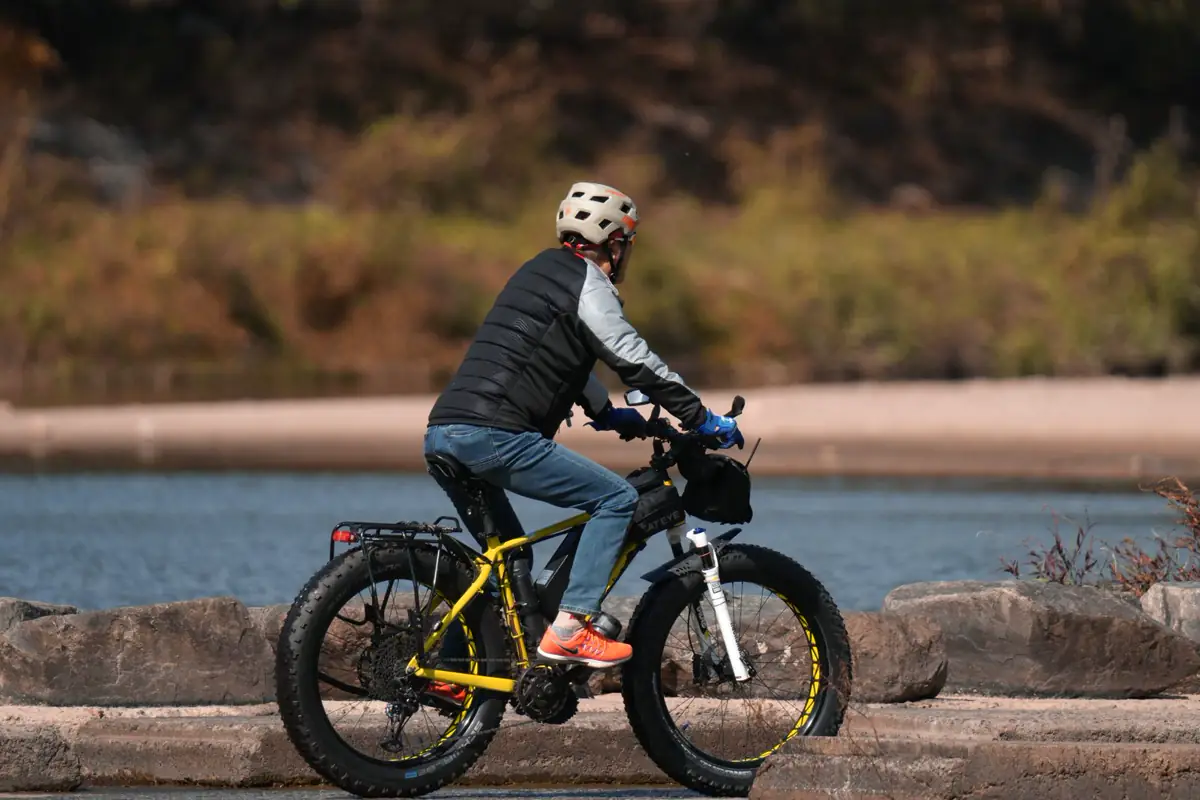
A heavy rider is shopping for a published weight limit with room left over, not for the lightest bike in a general roundup. The first number is how much the manufacturer says the bike can carry. The second is whether that number is a rider cap, a rack cap, or a combined total. A 750 watt hub on a frame rated to 300 pounds is the wrong bike if you are already near 300 pounds before the lock and the groceries.
This guide compares four current bikes with a published total of 400 pounds or more: the Lectric XPedition 2.0 dual-battery build, the Ride1Up Vorsa FT, the Velotric Discover 2, and the Aventon Aventure 3. Prices were checked on October 10, 2026. We have not ridden them. Figures come from manufacturer pages. An owner comment, where one appears, is one report on the brand's own site.
If the real question is the climb, read the steep hills guide. If the budget is the constraint, the under-$2,000 comparison overlaps three of these bikes.
Read the weight rating before the motor
The brands do not use these sentences the same way.
Total payload. Ride1Up prints 440 pounds for the Vorsa and the Vorsa FT. Velotric prints a 440 pound max bike load on the Discover 2. Aventon prints a 400 pound total weight limit on the Aventure 3. Lectric prints 450 pounds and then splits it.
Rider cap. Only Lectric publishes one here: 330 pounds. A 340 pound rider is over the limit with empty racks. The other three do not publish a separate rider maximum, so a spec sheet cannot prove that a 320 pound rider is inside the design. It can only show a total of 400 or 440.
Rack cap. This is where a big headline misleads. The Discover 2 rack is 66 pounds, so it fits a heavy rider with a backpack and not a child seat plus a week of groceries. The Vorsa FT rack is 150 pounds. The XPedition rear rack is 300 pounds, with a 30 pound front basket, and the rider is still capped at 330. Lectric also says not to load the bike on the kickstand.
Aventon's wording is the fuzzy one. The spec list says "Total Weight Limit 400 lbs." An Aventon article describes that 400 pounds as rider, gear, and bike combined. The step-over is listed at 76 pounds. If the bike counts inside the 400, rider plus cargo is about 324 pounds, not 400. We are not treating the article as a lab report, and we are not ignoring it. If you are over 300 pounds, ask Aventon which reading the frame was tested to.
Do not plan to live at the ceiling. A 280 pound rider with a bag and a lock is already a different load than the 165 or 187 pound rider in the range footnotes. The ceiling is a limit, not a target.
Frames, wheels, and brakes
The motor does not hold you up. The frame, the wheels, and the brakes do.
Aventon describes a 6061 aluminum frame with a gravity-cast front triangle. Ride1Up rates the standard Vorsa and the FT at 440 pounds and the Lite at 350. If a configurator offers the Lite because it is cheaper, it is the wrong edition for this job. Velotric says the Discover 2 frame exceeds ISO 4210 by 150 percent and supports 440 pounds.
Wider tires and more spokes spread a heavy rider out. The Aventure 3 uses 26 × 4.0 inch tires and 36-hole rims. The Vorsa FT uses 26 × 4.0 inch Kenda Krusade tires. The Discover 2 uses 27.5 × 2.4 inch tires, which is a pavement choice. The XPedition uses 20 × 2.5 inch street tires so the long rack can sit low. Those small tires are a poor match for sand.
Fat tires add rolling resistance and cost range on smooth pavement. They buy a larger contact patch. Take them if the riding includes gravel, snow, or a soft path. Skip them if the riding is only city pavement and the Discover 2's narrower tire keeps the listed weight down.
All four bikes use hydraulic discs. The Vorsa FT is the outlier on rotor size: 203 mm rear, 180 mm front. The other three are 180 mm front and rear. We have not measured stopping distance. On a steep descent near the weight limit, the larger rear rotor is the published difference to notice.
A high top tube is harder to swing a leg over. The Discover 2 is a step-through, 4 feet 11 inches to 6 feet 4 inches across two sizes. The Vorsa comes as a step-through (5 feet 0 inches to 5 feet 11 inches) and a step-over (5 feet 5 inches to 6 feet 4 inches). This table's Aventure 3 is the step-over, 5 feet 3 inches to 6 feet 4 inches. The separate step-through Aventure 3 is listed at 77 pounds, the same 400 pound limit, and 4 feet 11 inches to 6 feet 1 inch. The XPedition lists a 21 inch standover and a rider height of 4 feet 11 inches to 6 feet 5 inches.
Lectric XPedition 2.0 dual battery
Lectric is the only brand here that publishes the split: 450 pounds total, 330 rider, 300 on the rear rack, 30 in a front basket. The dual-battery page we priced was $1,799 on October 10, 2026, against a $2,344 compare-at price. The spec block says two 48 volt, 13 amp-hour packs, 1,248 watt-hours combined, and up to 120 miles. The overview also says up to 35 amp-hours, while the spec block says 26 amp-hours combined. The table uses 1,248 watt-hours and does not average the amp-hour lines.
The motor is a 750 watt rear hub, 1,310 watts peak, 85 Nm, with a torque sensor and an 8-speed Shimano Altus, 11–32. Class 1, 2, or 3. Brakes are hydraulic, 180 mm. Tires are 20 × 2.5 inch. Bike weight is blank in the table because Lectric published 65 pounds without batteries and 9 pounds each, not one ready-to-ride figure. A single-battery XPedition is a different price and range. Do not assume it shares this sale price.
Ride1Up Vorsa FT
The FT starts at $1,695. It is a 750 watt AKM rear hub with 95 Nm, the highest torque in this guide. Peak watts are not published. Payload is 440 pounds, the rack is 150 pounds, and the tires are 26 × 4 inch Kenda Krusade. Brakes are hydraulic, 203 mm rear and 180 mm front. It ships as Class 2 and can be set to Class 1, 2, or 3. Claimed range is 30 to 60 miles depending on weight, terrain, and assist, which is a more useful sentence than a single maximum with a light-rider footnote.
The battery is 48 volts, 15 amp-hours, called 720 watt-hours on Ride1Up's launch article. Gearing is Shimano Acera 8-speed, 48 tooth chainring, 11–32 cassette. That is a modest low gear, and a hub motor cannot multiply torque through it. The hills guide explains why. Ride1Up does not publish a clean FT weight or a rider cap separate from 440 pounds. The Lite is described as around 60 pounds and about 10 pounds lighter than the standard. That is approximate, so we did not print 70. The FT carton is about 105 pounds, which is the box, not the bike.
Ride1Up sells direct, lists phone support, and says U.S. ambassadors offer test rides. The product page lists a one-year warranty with an asterisk. Read that policy before you treat one year as the whole story.
Velotric Discover 2
The Discover 2 was $1,499 on October 10, 2026, from $1,999. Payload is 440 pounds and the rack is 66. A 280 pound rider plus a small bag can fit both numbers. A 100 pound crate on the rack cannot, even if the frame headline still has room. Listed weight is 63 pounds without fenders, kickstand, and pedals, the lightest figure in this guide, with those parts still to add.
The spec sheet says 48 volts, 750 watts, 75 Nm, and does not list peak watts. A chart on the same page gives the Discover 3 a 1,100 watt peak and does not give one to the Discover 2. A feature line also says "750w/1100w Peak Motor." Those lines conflict, so peak watts are blank. The battery is 705.6 watt-hours. Claimed pedal-assist range is 75 miles for a 187 pound rider in Eco on flat roads, with throttle range listed at 60 miles. Class 1, 2, or 3. Tires are 27.5 × 2.4. Brakes are Tektro hydraulic, 180 mm. Gearing is Shimano 8-speed, 46 tooth ring, 11–32. Velotric cites 1,600-plus U.S. stores.
Seventy-five newton-meters is the lowest torque here. It is enough to include the bike for payload, price, and step-through fit. It is the one we would leave behind for a sustained steep grade.
Aventon Aventure 3
The step-over was $1,999 on October 10, 2026. The spec list says 76 pounds, a 400 pound total weight limit, a 750 watt hub, 80 Nm, and 1,440 watts in Boost Mode for up to 30 seconds at up to 120 percent of the specced torque and power. Boost is a surge, not a continuous rating. The battery is 733 watt-hours. Claimed range is up to 65 miles for a 165 pound rider on flat pavement in Eco. Tires are 26 × 4.0. Brakes are Tektro hydraulic, 180 mm. Gearing is Shimano Altus 8-speed, 12–32. Class on the spec list is Class 2. The fork has 80 mm of travel and the seatpost has 50 mm.
The step-through page lists 77 pounds, the same 400 pound limit, and a fit of 4 feet 11 inches to 6 feet 1 inch. We did not confirm a separate price, so the table price is the step-over. Aventon prints 1,800-plus shops and a two-year warranty on its frames, components, and batteries, plus a lifetime frame warranty with registration. That is a service reason to pick it. It does not raise the weight limit.
One reviewer on Aventon's page, who said they weigh about 320 pounds, wrote that the suspension seatpost bottoms out. That is one report, not our measurement. Budget for a firmer post if you are in that range. If the rides are actually steep, the Aventure M in the hills guide keeps the 400 pound limit and the 733 watt-hour battery and adds a mid-drive. It costs more, and it does not ship with a throttle.
Specs side by side
| Bike | Price | Drive | Motor | Torque | Battery | Claimed range | Payload | Max rider | Bike weight | Rider height | Frame | Tires | Class |
|---|---|---|---|---|---|---|---|---|---|---|---|---|---|
| Lectric XPedition 2.0 Dual Battery (opens in a new tab) | $1,799 | Rear hub | 750 W nominal · 1,310 W peak | 85 Nm | 1,248 Wh | Up to 120 miles | 450 lb | 330 lb | — | 4'11"–6'5" | Longtail cargo | 20" × 2.5" | Class 1, 2, or 3 |
| Ride1Up Vorsa FT (opens in a new tab) | Starting at $1,695 | Rear hub | 750 W nominal · — peak | 95 Nm | 720 Wh | 30–60 miles | 440 lb | — | — | 5'0"–5'11" step-through, 5'5"–6'4" step-over | Step-through and step-over | 26" × 4.0" | Class 1–3 (ships as Class 2) |
| Velotric Discover 2 (opens in a new tab) | $1,499 | Rear hub | 750 W nominal · — peak | 75 Nm | 705.6 Wh | Up to 75 miles pedal assist | 440 lb | — | 63 lb | 4'11"–5'9" Regular, 5'6"–6'4" Large | Step-through | 27.5" × 2.4" | Class 1, 2, or 3 |
| Aventon Aventure 3 (opens in a new tab) | $1,999 | Rear hub | 750 W nominal · 1,440 W peak | 80 Nm | 733 Wh | Up to 65 miles | 400 lb | — | 76 lb | 5'3"–5'10" Regular, 5'10"–6'4" Large | Step-over | 26" × 4.0" | Class 2 |
How to read the blanks
- Lectric XPedition 2.0 Dual Battery. This row is the dual-battery configuration: two removable 48V 13Ah batteries, 26Ah and 1,248Wh combined.
- Lectric XPedition 2.0 Dual Battery. Lectric splits the 450 lb payload: max rider 330 lb, rear rack 300 lb, front basket 30 lb.
- Lectric XPedition 2.0 Dual Battery. Bike weight is published as 65 lb without batteries. Each battery is 9 lb. A single ready-to-ride weight is not published, so bike weight is left blank.
- Lectric XPedition 2.0 Dual Battery. Claimed range varies with load, terrain, and weather. Lectric also says the dual-battery pack is up to 35Ah in the overview copy; the specification block for this configuration says 26Ah combined.
- Ride1Up Vorsa FT. Starting price $1,695 on the Vorsa platform page. Same motor, battery, payload, and brake spec as the standard Vorsa.
- Ride1Up Vorsa FT. Tires are 26 × 4 inch Kenda Krusade. Rear rack is rated 150 lb. Payload is 440 lb.
- Ride1Up Vorsa FT. Peak watts and a ready-to-ride bike weight are not published. The FT shipping carton is about 105 lb, which is not the bike weight.
- Ride1Up Vorsa FT. The Vorsa Lite is a different edition: about 10 lb lighter, no rack, 350 lb payload. Do not use the Lite numbers for this row.
- Velotric Discover 2. Listed at $1,499, down from $1,999 on the product page.
- Velotric Discover 2. Spec sheet lists the motor as 48V, 750W, 75Nm, with no peak watts. A comparison table on the same page gives Discover 3 a 1,100W peak and does not give Discover 2 one. A feature line on the page also says '750w/1100w Peak Motor.' Peak watts are left blank because those two statements conflict.
- Velotric Discover 2. Range footnote: a 187 lb rider, PAS 1, Eco mode, flat roads. Throttle range is listed separately at 60 miles.
- Velotric Discover 2. Bike weight of 63 lb excludes fenders, kickstand, and pedals.
- Velotric Discover 2. Rear rack capacity is 66 lb, separate from the 440 lb max bike load.
- Velotric Discover 2. Default speed is 20 mph. The adjustable range is 12–28 mph.
- Aventon Aventure 3. Price is $1,999 on Aventon's product listing, checked October 10, 2026.
- Aventon Aventure 3. This row is the step-over. The spec list says 76 lb. A separate step-through listing says 77 lb, the same 400 lb total weight limit, and a rider height of 4'11"–6'1".
- Aventon Aventure 3. Peak power is Boost Mode: 1,440W, described as up to 120% of specced torque and power for up to 30 seconds.
- Aventon Aventure 3. Battery is 36V, 20Ah, 733Wh, LG 21700 cells.
- Aventon Aventure 3. Range footnote: a 165 lb rider, paved flat road, Eco mode, default Ride Tune.
- Aventon Aventure 3. Aventon's spec list calls 400 lb a total weight limit. An Aventon article also describes that 400 lb figure as rider, gear, and bike combined. Those two readings are not the same thing. We did not guess which one the frame was tested to.
- Aventon Aventure 3. Fork is an 80 mm suspension fork with lockout. A suspension seatpost with 50 mm of travel is included.
A dash means the figure was not published, or official pages disagreed. The notes under the table are the sentences those dashes are protecting.
How to choose without a test ride
Write down what you weigh, what you carry on a normal day, and the hill you cannot avoid. If rider plus cargo is over 330 pounds, the XPedition's rider cap is already a no. If the cargo alone is over 66 pounds, the Discover 2's rack is the no.
Then look at storage. None of these is a folding apartment bike. The XPedition is long, and its ready-to-ride weight is unpublished. The Vorsa FT weight is unpublished. The Discover 2 is the only listed weight in the 60s, and that listing leaves parts off. Do not buy a 400 pound rating and then discover the stairs are the real constraint.
Aventon and Velotric publish large U.S. shop counts. Ride1Up and Lectric are direct, with their own support lines. A heavy rider uses pads, spokes, and tires faster than the rider in a range footnote. A shop that will work on the bike is part of the fit.
Use the range footnote, not the billboard. If the test rider is 165 or 187 pounds and you are 260, you will not get the claimed mileage. We have not measured how far under. Budget a shorter loop, or buy the larger battery when the brand actually sells one. The XPedition's dual pack is the blunt way to buy watt-hours. It does not repeal the 330 pound rider cap.
Keep tire pressure inside the range on the sidewall. Heavier riders generally want the higher end of that range on pavement. We are not printing a PSI chart. If two bikes both clear your weight with margin, take the rack that matches your cargo and the rotor and torque that match your hills.
What we are not saying
These are four citable models, not the only legal bikes a heavy rider can use. A 440 pound payload is not permission for a 440 pound rider. We are not ranking by commission. The order of the table is who states the weight rules, who has torque and a large rack, who is lightest and cheapest, and who pairs fat tires with a shop network.
Spec sources
Every number in the table comes from one of these manufacturer pages. Retailer and review sites were not used as spec sources.
Lectric XPedition 2.0 Dual Battery
Ride1Up Vorsa FT
Velotric Discover 2
Aventon Aventure 3